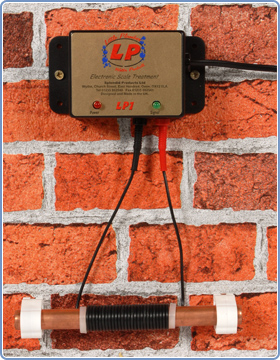
Olympia 3 in 1
Our electronic water softeners and water descalers are guaranteed to:
- Remove your existing limescale
- Prevent any new limescale forming
- Save energy (up to 40%) of your heating bills.
- Be easy to fit with no plumbing skills required
- To treat any type of pipe- plastic or copper
- Require no chemicals or salt
- Retain healthy minerals in your water
- Help remove skin problems such as eczema
- Make the water softer
- Electronically soften your water
Little Plumber water softener treatment units are guaranteed to remove and prevent limescale and make your water feel softer. They will continue to soften the water continuously without requiring any additives once connected to the mains (or via our battery unit the LP SOLO)
How they work
This is how your Electronic Water Descaler works:-
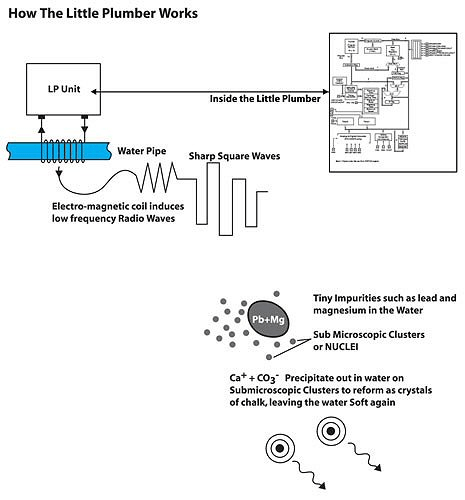
By coiling aerials around the cold water feed to a building or individual appliances, a series of very low frequency radio frequencies can be induced electronically into the water.
These frequencies run in BOTH DIRECTIONS in the body of the water and cause the bonding together of tiny impurities, probably atoms of Iron or Lead or other metals to produce clusters. These minuscule “sub-microscopic clusters” are so small that they cannot be seen by normal optical methods.
Remaining in the water in huge quantities for up to 8 hours they nevertheless will start to break up as soon as the water loses connection with the main body of water being treated and the frequencies stop. This is important with water in a header tank, which is unconnected with the rising main. Here the water rapidly loses its conditioned status so it is essential to treat the water again particularly as the water from the header tank goes into the hot water cylinder which scales up rapidly if left untreated. The LP2 unit has been designed for just this purpose as it has two sets of aerials and so can treat the rising main and the cold down service to the hot water cylinder.
Now, when the cold water is heated, the Calcium and Carbonate ions in solution (the dissolved salts of chalk) use these clusters as nuclei for crystal formation instead of the normal deposit areas such as heating elements. The reason for this is that the total surface area of the clusters is so vast that they become the preferred alternative for crystal seeding. The result is water in which the Calcium and Carbonate ions have deposited out to form what can be likened to “chalk dust” in the body of the water. These tiny crystals remain in suspension and do not form deposits although they can form a white sludge at the bottom of a tank if the water is static.
Once this “chalk dust” has been formed, the surrounding water is now much softer although there will still be some free Calcium ions so the water cannot claim to be totally soft-just softer. The softer water causes Limescale to now gradually break down and eventually even the most scaled up appliance will become free of scale.
What the experts say - Andrew Goldsworthy
Electromagnetic Water Conditioners – The Theory by Andrew Goldsworthy 2006
Physically conditioned water (or magnetic water as it is sometimes called) was first discovered by the Russians around the beginning of the last century. It was originally made by making water flow rapidly (around a metre per sec) between the poles of a moderately powerful permanent magnet (100 mT or more). Water treated in this way had the power to remove and prevent the formation of limescale in boilers and plumbing. It also had biological effects such as the stimulation of plant growth and rapid changes in the size of animal internal organs (See Presman AS “Electromagnetic Fields and Life” Plenum Press NY 1970).
Magnetic fields almost certainly have more than one effect on water (See www.lsbu.ac.uk/water) but probably the most relevant from our standpoint is their effect on suspended colloidal particles.
Most colloids of biological origin are negatively charged and attract a shell of positively charged ions, with di or multivalent ions dominating because of their extra charge. When water containing these particles flows through a magnetic field, the Lorentz forces drive the negative particles and their oppositely charged ionic shells in opposite directions. The effect is greater for ions, such as calcium, with more than one charge and these tend to be preferentially lost from their parent particles and replaced by less affected monovalent ions. This leaves the particles in the conditioned water in a metastable state, which is relatively deficient in calcium. They can then attract ambient free calcium ions to restore their original stable state. During this period, they act as excellent nuclei for the crystallisation of calcium salts, so that when the water is heated the salts that would normally form hard limescale on the hot surface, crystallise on the particles instead and remain in suspension. If the conditioned water is flowing rapidly, it can even remove scale that has already formed.
The conditioning effect of a permanent magnet conditioner increases with the speed of water-flow and also with the strength of the magnet (i.e. it is the rate of change of the magnetic field that matters) however there are practical limits to both. To some extent, it can be improved by having several magnets so that the water is conditioned repeatedly, but there is also a limit to this.
Electronic water conditioners avoid these problems by making the magnetic field move rather than the water. They use pulses of the order of microtesla delivered at several kHz from coils around the water supply pipe. The very rapid rate of change of the field at the beginning and end of each pulse now gives the conditioning effect and high field strengths are no longer required. Also, the high frequency improves matters by giving multiple conditioning cycles as the water passes relatively slowly through the coils.
As you can see from the above, pulses or square waves will be more effective than sine waves but polarity doesn’t seem to be important. Moderately high frequencies (usually in the audio range) are used to give multiple conditioning cycles as the water flows through the device. Sometimes water conditioners sweep the frequency used by an octave or so to exploit any possible resonance effects in the ion exchange process, and sometimes relatively complex wave forms are used with several frequencies superimposed. They don’t use the ion cyclotron frequencies for inorganic ions since these fall into the ELF region (e.g. calcium is 32Hz and potassium is 16Hz in the Earth’s magnetic field). It is conceivable that such frequencies might improve the rate of exchange of the relevant ions on the colloidal particles, but this would be more than offset by the reduced number of cycles to which the water is exposed during its passage through the conditioner.
Finally, just one more point about the use of permanent magnets to condition water. It is in fact possible to condition stationary water with a permanent magnet, but the process is very slow (of the order of hours). This is because there has to be motion through the field to provide the necessary energy. In this case, it probably comes from the Brownian movement of the colloidal particles in the stationary field and it is relatively infrequent that these will acquire enough energy to drive the necessary ion exchange.
Andrew Goldsworthy BSc PhD
Honorary Lecturer
Plant and Microbial Sciences
Imperial College London
The Science behind the LP range by Dr W. Abioun
Hard water is water, which contains the dissolved salt of Calcium Carbonate. Acidic rainwater falling through a geological rock formation consisting of Calcium Carbonate crystals such as Limestone or similar causes it to dissolve into the water. The main reason the rain becomes acidic is because Carbon Dioxide gas (the greenhouse gas) becomes absorbed by the rain turning it into a weak acid called Carbonic acid. It is this acid that dissolves away the Limestone rock. The dissolved salts become free ions of Ca++ and HCO3– and these stay in solution until the water is heated at which point the Carbon Dioxide “blows off” and the ions join together again to form solid crystals of Limescale. A sudden reduction in cold water pressure will also remove the CO2 (Carbon Dioxide) and cause precipitation. This can be seen in cold water pipes where there is a sharp bend and scale develops and on the washers on cold taps, both places where the pressure can change suddenly.
The hardness of the water depends on how rich it is in free Calcium ions. The higher the Calcium contents the harder the water. Of course, hard water is very good for your health. It is the fundamental building block for teeth and bones. It also has a beneficial effect on the heart. Soft water is reckoned not to be so good for you.
To make hard water soft it is necessary to remove the Calcium ions in solution and this is normally done with a water Softener using salt. Here, the Sodium ions in the salt (Na+) are exchanged for Calcium ions in the water. This process is known as “ion exchange”. Many people however because of the cost, plumbing requirements and addition of chemicals now favour the preferred method of hard water treatment – ELECTRONIC!
So, how else can we sort out the problem of free Calcium ions in hard water? The answer is by treating the water with a selection of low frequency electro-magnetic radio waves.
This is how it works:
By coiling aerials around the cold water feed to a building or individual appliances, a series of very low frequency radio frequencies can be induced electronically into the water. This effect runs in BOTH DIRECTIONS in the body of the water and causes the bonding together of tiny impurities, probably atoms of Iron or other metals. These minuscule “sub-microscopic clusters” are so small that they cannot be seen by normal optical methods. Remaining in the water in huge quantities for up to 8 hours they nevertheless will start to break up as soon as the water loses connection with the main body of water being treated. This is important with water in a header tank, which is unconnected with the rising main, but providing the water is used in a reasonable period, it still remains “conditioned” and will continue to perform by preventing and removing limescale.
Now, when the cold water is heated, the Calcium and Carbonate ions in solution use these clusters as nuclei for crystal formation instead of the normal deposit areas such as heating elements. The reason for this is that the total surface area of the clusters is so vast that they become the preferred alternative for crystal seeding. The result is water in which the Calcium and Carbonate ions have deposited out to form what can be likened to “chalk dust” in the body of the water. These tiny crystals remain in suspension and do not form deposits although they can form a white sludge at the bottom of a tank if the water is static.
Once this “chalk dust” has been formed, the surrounding water is now much softer although there will still be some free Calcium ions so the water cannot claim to be totally soft-just softer. The softer water causes Limescale to now gradually break down and eventually even the most scaled up appliance will become free of scale.
Strangely enough, the amount of energy required to achieve this conditioning effect is quite small and the skill is in producing a sharp clean square wave. Little Plumber employs a specially designed digitally enhanced circuit to produce an extremely efficient range of square waves with low power consumption. There is simply no need to produce huge voltage outputs to achieve excellent results. This is simply like taking a “sledge hammer to crack a nut”
Dr Abioun has conducted research into the efficacy of electronic water conditioners.